Leo After Midnight: A Lowerhouse Back-Garden Meteor Tally for November 2026
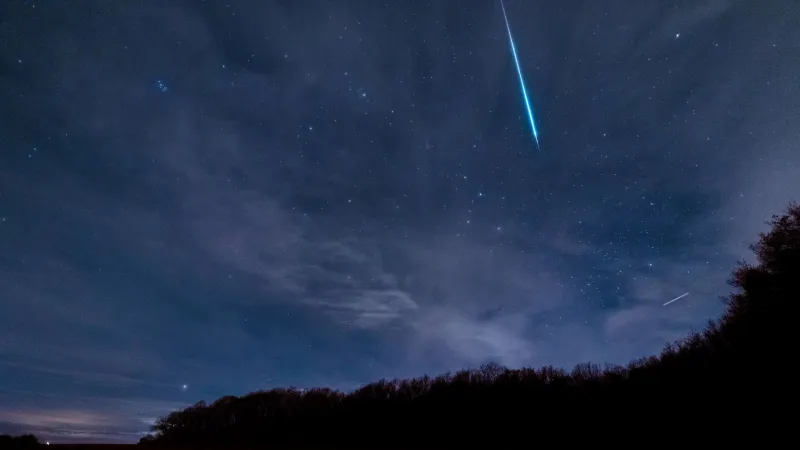
There is something pleasantly odd about standing in a cold British garden at midnight, waiting for a speck of space dust to scratch the sky. The Leonid meteor shower is one of the year’s reliable celestial appointments, and in November 2026 it gives Lowerhouse families a ready-made excuse to look up.
The Leonids are not a fireworks display. They are more like a slow, quiet tally — a handful of bright streaks, a few faint flickers, and long stretches of nothing much. That is exactly why they suit junior scientists. You are not just watching; you are counting, comparing and wondering why the numbers change.
What makes a Leonid?
Every year in mid-November, Earth passes through a stream of debris left behind by Comet Tempel-Tuttle. The comet itself is long gone from our neighbourhood, but its trail of tiny grains remains. When one of those grains hits our atmosphere at high speed, it burns up and produces the streak we call a meteor.
The Leonids appear to radiate from the constellation Leo, which gives the shower its name. You do not need to find Leo precisely — the meteors can appear anywhere in the sky — but knowing the radiant helps explain why the best viewing is usually after midnight. As Earth turns, Leo climbs higher, and the shower’s geometry becomes more favourable.
For 2026, the peak is expected around the night of 17–18 November, with activity also worth checking a night before and after. This is not a famous “meteor storm” year. Think modest rates rather than hundreds per hour. A good result from a UK back garden might be a few meteors in half an hour, with luck and dark skies on your side.
Why meteor counts vary so much
If you compare notes with a friend in another town — or another year — the totals may not match. That is normal. Meteor counting is a messy, real-world science.
First, the comet’s debris is not spread evenly. Some years Earth clips a denser ribbon; other years we pass through thinner material. The Leonids are also famous for occasional outbursts linked to the comet’s roughly 33-year orbit, though 2026 is not predicted to be one of the big storm years.
Second, the Moon matters. A bright Moon washes out faint meteors. Third, local light pollution and cloud cover can halve your count without you noticing. And fourth, human factors count: tired eyes, a warm kitchen window, a neighbour’s security light switching on at the wrong moment.
That is why scientists ask observers to record conditions as well as numbers. A count of four meteors under cloudy skies in a lit street is not the same as four under a clear, dark sky.
A Lowerhouse tally sheet for 17–18 November
You do not need special equipment. A clipboard, a pencil, a red-light torch and a flask are enough. Red light helps preserve night vision, and it looks pleasingly serious.
Try this simple sheet for each 15-minute session:
| Time started | Time finished | Cloud cover (clear / patchy / cloudy) | Moon visible? | Meteors counted | Brightest meteor notes |
|---|---|---|---|---|---|
Add a column for “where in the sky” if you like — for example, “above the shed”, “towards the oak tree”, “low over the fence”. This helps younger pupils realise that meteors are not all in one place, even though they seem to come from Leo.
Keep sessions short. Ten to fifteen minutes of focused looking is plenty for a junior scientist. Then swap observers, drink something warm and compare notes. A tally is more fun when someone else is doing the shivering too.
Street lights, bedtime and other practicalities
UK gardens are rarely truly dark. Street lights, porch lamps and background glow all reduce what you can see. You cannot switch off the street, but you can improve your chances.
Stand with your back to the brightest lamp. Let your eyes adapt for at least ten minutes — no phone screens. If you must use a torch, cover it with red paper or a red plastic bag. Choose a corner of the garden or school field that is shielded from direct glare. A hedge, shed or wall can help.
Bedtime is the real challenge. The Leonids are best after midnight, which is not ideal for a school night. Families can treat the peak as a special late-evening event: look from about 9pm to 10pm on 17 November, then set an alarm for a short 15-minute check after midnight if the household is willing. Younger children might prefer a “moonlight-and-meteor” session before bed, with a parent recording the official count later.
If your school has a science club, ask whether a small group can meet on the field before registration or at a supervised evening event. A whole-class tally can be pooled the next morning, with cloud cover notes and a few sketches. That is genuine citizen science, not just a late night.
What to write down — and what not to promise
Record what you actually see, not what you hoped to see. A faint meteor counts as a meteor, but note that it was faint. If you are unsure, mark it as “possible” and keep a separate column. Scientists prefer honest uncertainty to invented precision.
And do not promise a spectacular show. The Leonids are fascinating precisely because they are unpredictable. Some years they deliver a memorable sprinkle; others they offer a modest trickle. Either way, the counting teaches patience, careful observation and the difference between a prediction and a guarantee.
So on 17–18 November 2026, put on a proper coat, turn off the phone, and give the sky fifteen quiet minutes. Whether you count two meteors or twelve, you will have joined a long tradition of people looking up and wondering what is out there.